
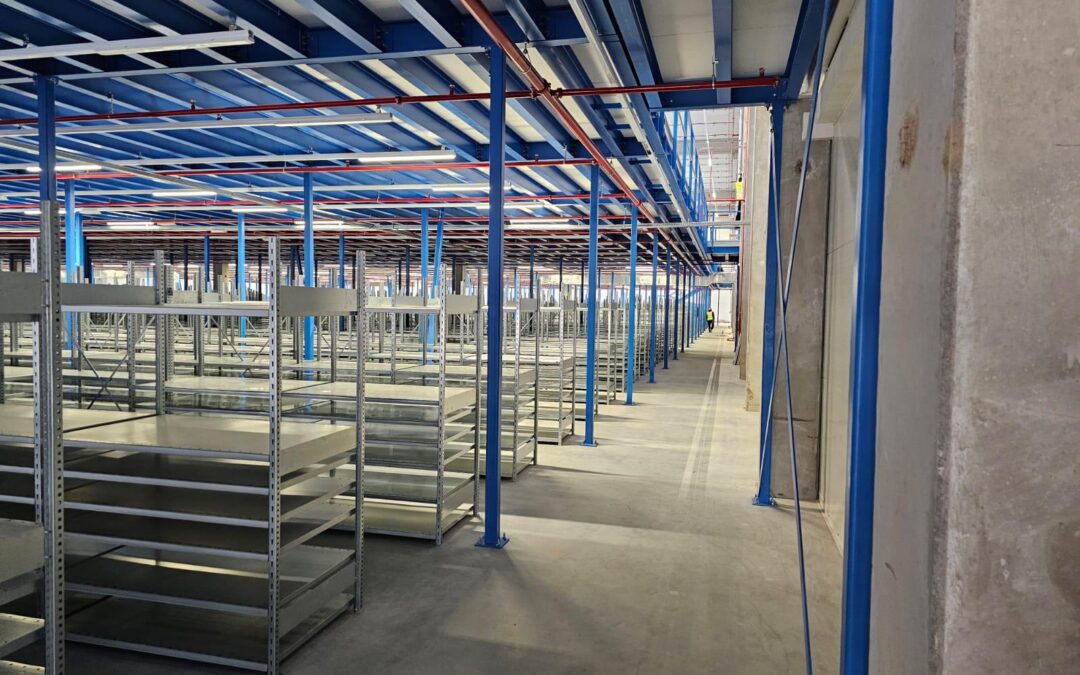
In the event of a fire, it is often thought that steel fails because it melts. In reality, steel loses its strength before it melts. When the temperature during a fire rises to approximately 1,000°C, most of the original load-bearing capacity has been lost. The structure fails well before the melting point of steel is reached. Without fire-resistant measures, a steel structure can therefore become unstable or even collapse within a short period of time.
What does fire resistance mean?
Fire resistance indicates how long a structure retains its load-bearing capacity during a fire. This is usually expressed as a fire resistance rating of 30, 60, or 120 minutes. The higher the rating, the longer the structure remains standing and the more time is available for evacuation and firefighting.
Structures made of cold-formed steel sections are particularly susceptible to rapid heating. In the event of a severe fire, these thin sections can lose their load-bearing capacity within just a few minutes, especially when the mezzanine is loaded with goods or equipment.
Steel fails in a fire due to a loss of strength, not because it melts
Fire resistance varies depending on the situation
Not every steel structure needs to be fire-resistant. The required fire resistance depends on various factors, such as:
- the presence of flammable goods;
- the use of sprinklers;
- the presence of employees on the upper floor or the ground floor;
- the client’s desired security levels.
In addition, requirements vary by country and, in the Netherlands, often even by municipality. In the Netherlands, local regulations and the fire department’s assessment often play an important role.

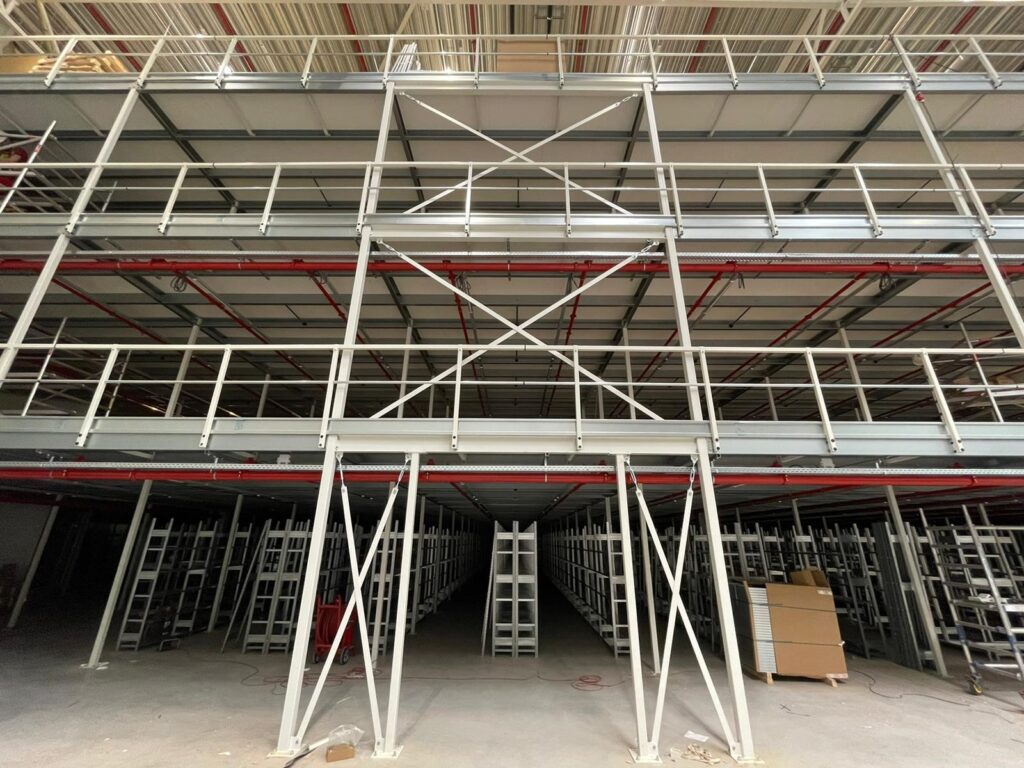
The effect of span and load
When designing a fire-resistant steel structure, our engineers consider not only the strength of the steel, but also the load and the span.
A floor that must be able to support 500 kg per m² is not designed to withstand exactly that load. To ensure a generous safety margin, we in the Netherlands must design the structure to withstand 150 percent of that load. That amounts to 750 kg per m². The size of this safety margin may vary by country.
In the event of a fire, it is also assumed that a floor is usually not under maximum load. That is why, in accordance with the standard, we calculate using a lower load. In this example, that is 400 kg per m². As a result, the structure has more reserve capacity to compensate for the loss of strength in the steel caused by the heat.
For larger spans, deflection also plays an important role in fire resistance. A floor may be strong enough to support the load, but may still perform less effectively due to deflection. That is why our engineers evaluate both the load-bearing capacity and the deflection of the structure.
“When it comes to fire resistance, we also consider load and span”
How to make a steel structure fire-resistant
There are several ways to make steel structures more fire-resistant.
- Fire-resistant coating
A commonly used solution is a special coating that foams up at high temperatures. This layer forms an insulating barrier around the steel and slows down the heating of the structure. A coating is relatively inexpensive, but it does require special care during transport and installation. Any damage must be repaired to maintain its fire-resistant properties. - Cladding with fire-resistant panels
Another method is to clad the steel structure with fire-resistant panels. This solution offers robust protection, but typically requires more installation time and is often installed on-site. For cold-formed steel sections, this is often an effective solution. - Structural fire resistance
Fire resistance can also be achieved through the design of the steel structure itself. For example, by using heavier sections or incorporating additional structural margin, the structure retains sufficient load-bearing capacity for a longer period during a fire.
“It’s the details that set Almacon apart”
Case study
Many projects consider a combination of measures, such as sprinklers, structural fire resistance, and protective cladding. By combining these measures in a smart way, it is often possible to achieve a cost-effective solution.
Read more here about a project featuring a sprinkler floor>
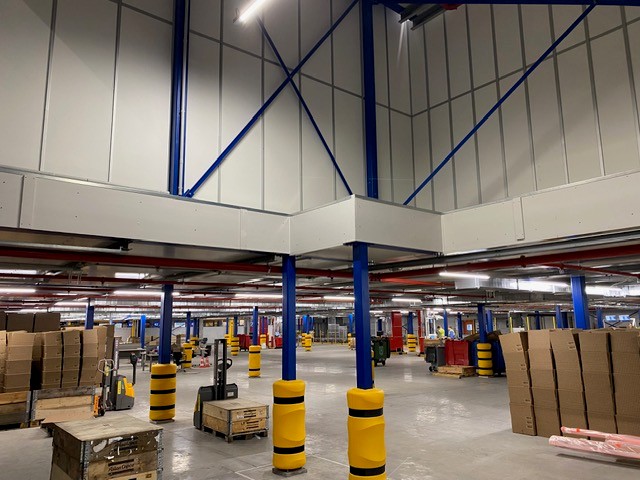
In a recent project, a client wanted a fully fire-resistant structure built. Because the warehouse was equipped with a sprinkler system, the required fire resistance rating was ultimately reduced.
In this project, we used hot-rolled steel sections. These sections naturally possess significant fire resistance, eliminating the need for additional coating. In addition, our engineers designed special features to control the expansion of the steel at higher temperatures.
The added value of Almacon
Fire safety requires specialized knowledge. Almacon uses advanced software and calculation tools to accurately analyze and design steel structures. Thanks to the extensive experience of our engineers, who have been with Almacon for many years, we are able to perform virtually all calculations and designs in-house.
In addition, we look beyond just the technical solution. We also pay close attention to the finish and overall appearance of a project. It’s the details that really set us apart.
Throughout the entire process, you’ll also have a single point of contact. This ensures clear communication, direct lines of communication, and a solution that is not only safe and practical but also tailored to your needs and your building.
Your options
Are you facing fire safety requirements at your distribution center? If so, a fire-resistant structure might be the solution you’re looking for. Please contact one of our engineers so we can discuss your specific situation.
📞 Call 079-3610663
📧 Mail info@almacon.nl
“Almacon literally and figuratively lifts customers up to a higher level”
Read also
Load-bearing sprinkler structure as a smart solution for fire safety in a tall distribution center
Mezzanine with long spans for more space and efficiency

Co-author of this article: Paul Voorduin
Project engineer
Paul Voorduin is a Project Engineer at Almacon and has been working on the engineering of steel structures for more than 25 years. His technical expertise, practical experience, and calm approach make him a valuable partner for colleagues and clients.